The Emotional Messaging Matrix
What happens when you apply the latest research in emotional psychology to brand messaging?
Get the Matrix to find out. It only takes 5 minutes to build your own with the included Gemini Gem.



Stop me if you’ve heard this before:
"People buy on emotion and justify with logic."
It's the oldest cliché in marketing. You know it. Your boss knows it. The intern knows it.
So why does your AI still write like emotions don't exist?
Your prompts say "benefit-driven copy" and your AI delivers competent sentences about efficiency and productivity.
Meanwhile, your customers feel anxious, overwhelmed, and desperate for a solution that gets them.
If your sales funnel is experiencing a mass exodus, it's a big sign that it's time you entered the Matrix.
That's not a film reference. The Matrix I'm referring to is a literal 3x4 grid that maps the entire spectrum of human motivation.
Psychologist J.D. Pincus (PhD) synthesised over 100 years of research, including:
Maslow's Hierarchy of Needs
Bowlby's Attachment Theory
Csikszentmihalyi's Flow Theory
Kohlberg's Theory of Moral Development
Erikson's Theory of Personality Development
McClelland's Needs for Achievement, Affiliation, and Power
And in his research, he proved that there are only 12 emotional needs that govern every decision we'll ever make:
Security
Empowerment
Belonging
Justice
Identity
Engagement
Nurturance
Morality
Mastery
Achievement
Esteem
Transcendence
Those 12 emotional needs are then organised into a 3x4 grid of human motivations:
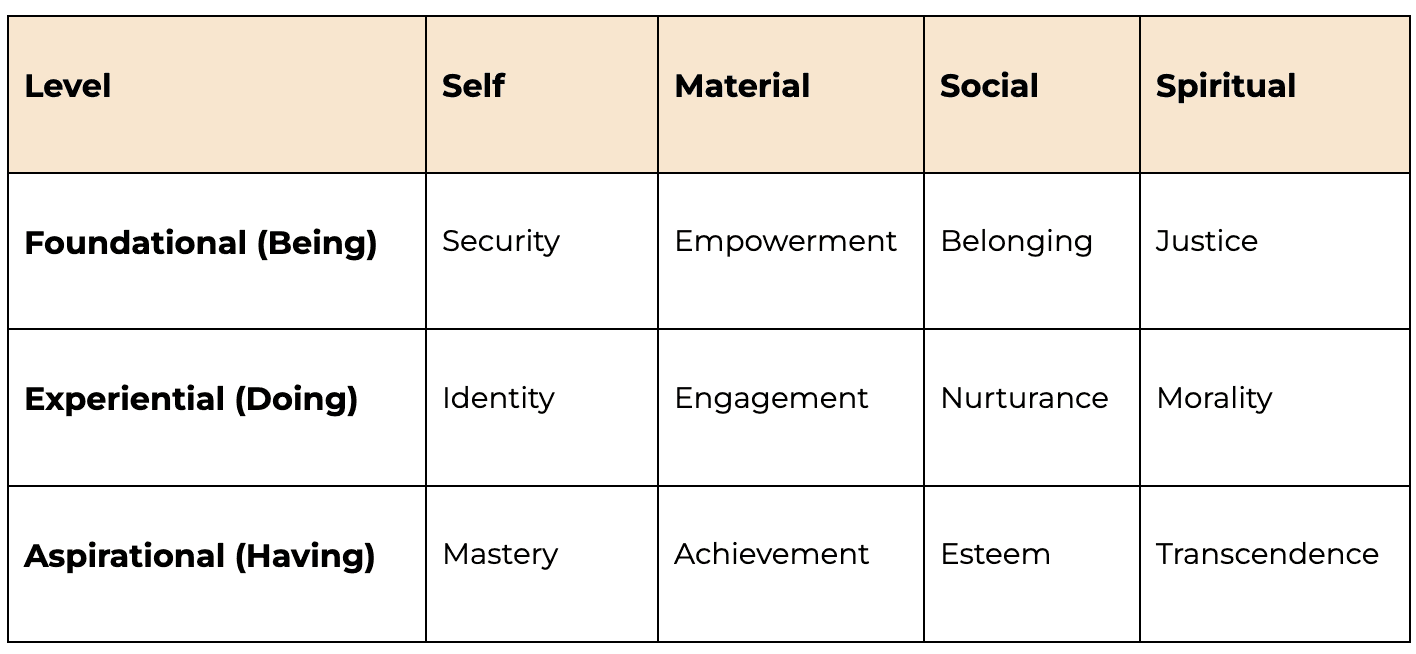
The beauty of this approach is its comprehensiveness: because there are no other possible life domains or levels of aspiration, the framework confidently accounts for every human need.
How to use the Emotional Messaging Matrix
If you have an AI copywriting setup in Gemini/Claude/ChatGPT, do the following:
Step 1: Download the Messaging Matrix and add your brand context to the provided Gemini Gem or Perplexity Space
Step 2: Ask for an Emotional Messaging Matrix
Step 3: Review the output and add it to your AI setup
Step 4: Enjoy better writing
If you don't have messaging guidelines yet, just type your homepage URL into the chat and hit enter.
(Yes, this is also great for competitor research.)
Please note that while the Gem is pretty sharp, I'm not the one who's going to solve AI hallucinations, so triple-check the output.
The more effort you put into building your Matrix upfront, the more value you'll get from it over time.
Here are 3 practical tests for emotional messaging:
1/ Headline & ad testing
Test different emotional needs in headlines, ads, or email subject lines. When you notice consistent conversion lifts from one or two needs, expand those across more marketing assets.
2/ Message architecture
Map pain points, features, and jobs-to-be-done to specific emotional needs and regulatory focuses (promotion vs. prevention). You'll write to what people actually fear or hope for—not just what they say they want.
3/ ICP differentiation
Different personas respond to different emotional triggers, even for the same product. The Matrix helps you identify which need is loudest in each moment and message, rather than forcing everyone into the same box.
Give AI the emotional intelligence it craves
LLMs are incredible at language but terrible at judgment.
They don’t feel:
Anxiety about loss
Pride in mastery
The pull of status
The fear of looking incompetent
You do. And so do your customers.
The Emotional Messaging Matrix is the upstream constraint that fixes AI output at the source. When this context is present, models stop sounding like polite interns who got their hands on a brand guide 2 hours ago.